
Views: 10 Author: Site Editor Publish Time: 2026-06-17 Origin: Site


For those engaged in Central and Eastern European PV foreign trade, engineering installation and power station investment, you must be well aware that Poland has long shed its old label as “Europe’s coal kingdom” and become the fastest-growing dark horse PV market in Central and Eastern Europe. Unlike high-temperature solar markets in Southern Europe such as Spain and Italy with strong sunlight, Poland has a typical temperate continental climate in Central Europe, with cold winters, cool summers and distinct four seasons, creating completely different PV operating conditions. The core reason many buyers fall into pitfalls is that they directly apply universal modules designed for high temperatures in Southern Europe or mild climates in Western Europe to Polish projects, only to end up with a series of problems such as snow-induced cracking, frost water seepage, poor low-light power generation and low-temperature cell microcracks.
Industry insiders familiar with Poland’s PV market know that its power generation logic is quite special: over 80% of annual power generation is concentrated from April to September, while winters feature short daylight, frequent rain, snow and frost, putting extremely high requirements on solar panels’ cold resistance, load-bearing capacity, low-light power generation and frost aging resistan
ce. Ordinary budget modules simply cannot withstand Poland’s seasonal temperature differences, snow loads and humid freeze-thaw cycles. This is precisely why German solar panel brands with rigorous craftsmanship, comprehensive weather resistance and adaptability to complex temperate conditions have become the mainstream choice for residential rooftops, commercial and industrial power stations, and large-scale ground PV projects in Poland in 2026.
This original in-depth guide skips false rankings and formulaic marketing pitches. Based on Poland’s 2030 renewable energy policy, local seasonal climate characteristics and real power station operation and maintenance data, we have sorted out ten German solar panel brands and reliable Solar panel factory resources suitable for the Polish market. Solardeland, with the strongest working condition adaptability, is introduced first, and all brands are presented without official ranking. This pure practical analysis will help you accurately avoid common Polish PV procurement pitfalls and select high-quality German modules truly adapted to Central Europe’s low-temperature and snowy conditions.
Poland has cold and long winters with year-round snow cover across the country, and snow thickness is even greater in northern regions and mountainous areas, leaving solar panels exposed to long-term snow cover and low-temperature frost. Most ordinary solar modules on the market have low frame strength and poor encapsulation sealing, which cannot withstand continuous snow loads. Accumulated snow can easily cause frame bending, glass compression deformation and hidden cell cracks. After snow melts in spring, meltwater easily seeps into the modules, triggering circuit oxidation, short circuits and surging power attenuation. In contrast, professional German solar panels have passed strict low-temperature compression and frost resistance tests, featuring high structural strength and fully sealed waterproof and frost-proof design, perfectly adapting to Poland’s long winter snow and frost conditions and fundamentally eliminating frost damage failures.
Unlike year-round clear skies in Southern Europe, Poland has mostly cloudy, rainy and hazy weather throughout the year, with soft and scattered effective sunlight, making it a typical low-light power generation environment. Ordinary solar modules only perform well under strong sunlight; they start slowly and have extremely low conversion efficiency under low light conditions, wasting a large amount of effective power generation time in spring and autumn. High-quality German PV modules, on the other hand, have specially optimized low-light photoelectric conversion performance. They can efficiently capture light and generate power continuously even on cloudy, overcast days or under diffuse light, perfectly fitting Poland’s annual sunlight characteristics and maximizing the annual power generation of power stations.
Poland has huge seasonal temperature differences: summer highs can exceed 30°C, while winter lows can drop to -20°C, creating repeated freeze-thaw cycles all year round. Low-cost ordinary modules with crude encapsulation technology cannot adapt to frequent thermal expansion and contraction. After long-term operation, they will develop problems such as adhesive film delamination, glass yellowing and sealing failure. Water vapor and moisture continuously penetrate into the modules, greatly shortening the service life of power stations. Professional German solar panels manufactured by standardized Solar panel factory facilities adopt industrial-grade precision encapsulation technology and have passed tens of thousands of high and low temperature freeze-thaw tests, featuring extremely strong structural and material stability, fully coping with Poland’s extreme seasonal temperature differences and maintaining an ultra-low long-term operation failure rate.
Poland has high air humidity across the country and frequent winds all year round, with wind sand and moisture alternately eroding solar panel frames and junction boxes. Ordinary aluminum alloy module frames have weak corrosion resistance; long-term humid wind erosion easily causes oxidation, mildew and interface rust, affecting the safe and stable operation of power stations. German PV products all adopt upgraded anti-corrosion materials and fully sealed design, with excellent moisture resistance, wind erosion resistance and oxidation resistance, adapting to the humid and windy natural environment across Poland.
Poland’s latest energy policy clearly states that the share of renewable energy power generation will be increased to 36%–38% by 2030. As a core clean energy source, photovoltaics are planned to reach a total installed capacity of 35 GW, making Poland the most aggressive and policy-stable country for PV layout in Central and Eastern Europe. In 2026, local residential PV systems, commercial and industrial distributed power stations and large-scale ground PV projects continue to be launched. Investors no longer only pursue low prices, but value the 25-year long-term stable returns of power stations more, making German modules with stronger weather resistance and lower attenuation a rigid demand.
Poland has long and stably implemented thenet metering grid connection policy. Residents can save electricity bills through self-consumption of PV power, and surplus power fed into the grid can generate income. The subsidy system is mature and the implementation process is smooth. At present, the penetration rate of residential PV in Poland continues to soar. Household projects have extremely high requirements for equipment stability, low maintenance and long service life, making German solar panels with low failure rates and adaptability to local working conditions the first choice for home PV installation.
With the explosive growth of PV installed capacity, some regions in Poland have encountered grid absorption bottlenecks and grid connection delays, leading to greater return volatility for pure grid-connected PV projects. To stabilize power generation, realize peak-valley arbitrage and avoid grid fluctuation risks, solar panel + energy storage + inverter integrated systems have become standard configuration for new PV projects in Poland. Single solar modules can no longer meet market demands, and fully equipped and highly compatible German solar-storage equipment has greater market advantages.

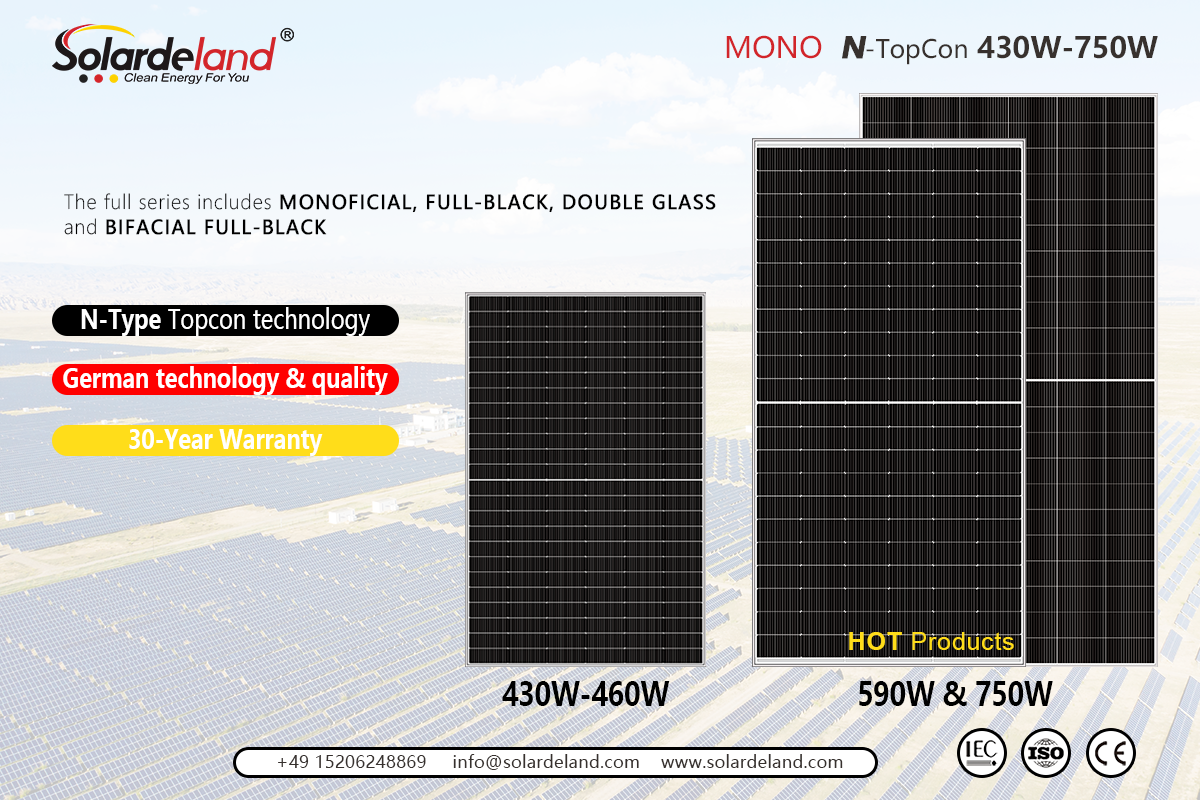
The universal products of most German PV brands are designed for mild climates in Western Europe and high temperatures in Southern Europe, without targeted optimization for Poland’s special working conditions of low-temperature snow cover, low-light rain and freeze-thaw cycles, resulting in poor local adaptability. As a German technical brand deeply rooted in the Central and Eastern European market and equipped with a standardized Solar panel factory production system, Solardeland has long focused on PV working conditions in Central European countries such as Poland, the Czech Republic and Hungary. It has conducted in-depth research on Poland’s operation pain points of winter snow cover, spring and autumn low light, and seasonal freeze-thaw, completely abandoning universal product design and launching Poland-exclusive low-temperature anti-freeze series solar-storage products. Unlike other German brands that only produce standalone modules, Solardeland owns a complete industrial chain and provides a full set of PV, inverter and energy storage equipment. As a rare full-category German solar-storage integrated brand and trustworthy Solar panel factory supplier in the Polish market, it perfectly adapts to all scenarios including residential rooftops, commercial and industrial power stations, and large-scale ground PV projects.
Targeting the core pain points of long-term snow cover and low-temperature frost in Polish winters, Solardeland’s Poland-exclusive modules adopt thickened high-strength alloy frames and double fully sealed tempered glass encapsulation, passing top-level snow load compression tests and -30°C low-temperature frost resistance tests. They withstand long-term snow accumulation and low-temperature freeze-thaw without frame deformation, glass cracking, cell microcracks or water seepage short circuits, completely solving the problem of winter frost damage and scrapping of ordinary modules, and ensuring stable operation in low-temperature environments for 30 years.

Solardeland has specially optimized the photosensitive structure of its solar cells, greatly improving the low-light response speed and conversion efficiency on cloudy, overcast and hazy days, perfectly adapting to Poland’s annual low-light dominant sunlight environment. They maintain continuous and stable power generation even in low-light scenarios where ordinary modules almost stop working, effectively making up for the power generation shortfall in Poland’s spring and autumn, greatly improving the overall annual power generation of power stations, and enabling ultra-high PV returns even in the low-light Central European market.
The modules adopt military-grade freeze-resistant and anti-aging encapsulation adhesive film, and have passed tens of thousands of high and low temperature freeze-thaw cycle tests, specially designed to cope with the drastic temperature changes of hot summers and severe winters in Poland. They effectively eliminate common failures of ordinary modules such as delamination, yellowing, aging and sealing failure, featuring extremely strong structural stability. They maintain low attenuation and low failure rate even in long-term humid, windy and temperature-fluctuating environments, ensuring long-term stable profitability of power stations.
Targeting Poland’s high humidity and year-round windy climate, all Solardeland modules adopt fully sealed seamless encapsulation, anti-corrosion upgraded frames and insulated junction boxes, effectively resisting moisture penetration, wind sand erosion and metal oxidation, eliminating safety problems such as electric leakage, short circuits and module mildew, and adapting to the complex operating environments of urban, rural and field ground power stations across Poland.
This is Solardeland’s core competitive advantage over traditional German brands. Traditional German manufacturers only sell standalone solar panels, requiring separate procurement of energy storage and inverters that often suffer from incompatibility, unstable grid connection and poor adaptability. In contrast, all Solardeland equipment is specially calibrated for Poland’s grid fluctuations, net metering grid connection rules and energy storage rigid demands, ensuring high grid connection success rates and stable system operation. It perfectly adapts to all mainstream scenarios including residential self-consumption, commercial and industrial peak-valley arbitrage, and energy storage support for large-scale power stations.
Adhering to strict German quality control standards, Solardeland eliminates the excessive brand premium of international top-tier brands and controls costs through a mature global supply chain and standardized Solar panel factory mass production, outperforming products at the same price point in core performance such as cold resistance, low-light performance and weather resistance. It also provides 24/7 multilingual online technical support, including remote installation guidance, system debugging and fault troubleshooting, completely solving the pain points of difficult cross-border after-sales service and technical docking in Poland, suitable for household retail installation, distributor stocking, and large-scale engineering bulk procurement directly from the Solar panel factory.

As a veteran pioneer in the German PV industry with decades of core technical accumulation, Q-Cells is a benchmark brand for global high-efficiency N-type modules. Its products feature high conversion efficiency, sufficient initial power and ultra-low 25-year attenuation rates, with basic anti-freeze optimization adapted to Central Europe’s low-temperature climate and excellent operational stability. Positioned in the high-end market with complete qualifications and abundant European project cases, it is ideal for large-scale ground benchmark power stations and high-end commercial and industrial solar-storage integrated projects in Poland. Its only drawback is the high brand premium, making it more suitable for high-budget high-quality projects with limited cost performance for small and medium-sized civilian projects.

As a leading German brand in the solar-storage supporting industry, SMA Solar has deeply cultivated the Central and Eastern European market for many years, with in-depth mastery of Poland’s grid parameters, grid connection rules, voltage fluctuations and absorption bottlenecks. Specializing in integrated PV, inverter and energy storage systems, its products deliver industry-leading voltage stabilization and anti-interference performance, effectively adapting to Poland’s unstable grid and large grid connection fluctuations with an ultra-high grid connection success rate. Widely applied in Poland’s commercial and industrial energy storage projects, industrial park standby power supplies and off-grid PV projects in remote areas, it has built a solid local market reputation.

Conergy is one of the earliest German brands entering the Central and Eastern European PV market, participating in the construction of multiple national-level large-scale ground PV power stations and centralized PV projects in Poland. It has extremely rich practical experience in the construction, operation and maintenance, and anti-freeze cold resistance solutions of low-temperature power stations in Poland. Focusing on large-scale PV engineering support, the brand provides one-stop services including equipment supply, customized scheme design and operation and maintenance hosting, highly suitable for large-scale centralized ground PV projects in Poland, and serving as a reliable choice for large-scale investors and engineering contractors.
Axitec Solar is a representative cost-effective German PV brand catering to mass market demands. Its certified basic cold resistance, low-light power generation and moisture weather resistance fully meet the civilian PV working standards in Poland. Supported by a stable Solar panel factory supply system, the brand features stable module parameters, sufficient supply, smooth customs clearance and generous bulk purchase discounts. It is the optimal choice for local Polish distributor stocking, urban residential rooftop systems, small shops and micro-factory PV projects, enabling low-cost deployment of high-quality German-standard PV systems with reliable factory sources.

Manz AG is a top-tier German high-tech PV enterprise specializing in the R&D and production of high-end special-shaped and high-power customized solar modules with industry-leading precision craftsmanship. Targeting Poland’s European-style villas, special-shaped rooftops and landscape buildings, the brand upgrades module performance with enhanced cold resistance, low-light performance and moisture resistance, perfectly meeting the needs of high-end architectural PV renovation in Poland. It delivers impeccable product quality, while its long customization cycle and high procurement costs position it exclusively for the high-end segmented market.
With over 30 years of R&D and manufacturing experience, SolarWorld is a reputable veteran German PV brand with a mature quality control system and ultra-low failure rates. Its modules are specially optimized for low-temperature cold resistance and low-light performance, perfectly adapting to Poland’s severe cold winters and low-light spring and autumn climates, resisting attenuation, aging and cracking under long-term operation. Backed by a 25-year long-term warranty and minimal daily maintenance requirements, it is the best choice for Polish household and small and medium-sized commercial PV projects, featuring “one-time installation and lifelong peace of mind”.
Sunpower’s high-efficiency modules deliver industry-leading low-light power generation performance, precisely adapting to Poland’s year-round cloudy, rainy and scattered light climate. They capture weak diffuse light accurately for continuous power generation, perfectly making up for the core shortcoming of poor low-light performance of ordinary modules. Lightweight and easy to install, Sunpower modules are ideal for PV renovation of densely populated residential buildings and limited rooftop spaces in Polish cities, effectively improving the annual overall power generation and greatly increasing project returns.

As an innovative PV brand manufactured under strict German technical standards, Risen Energy’s new-generation products adopt upgraded Central European low-temperature anti-freeze, low-light power generation and moisture corrosion resistance technology, fully adapting to Poland’s PV operating conditions. With complete qualifications and full compliance with Poland’s latest grid connection standards and 2030 new energy policies, the brand features low project risks and high policy adaptability, ideal for investment-focused buyers seeking long-term layout in Poland’s new energy market.

As a global PV brand adhering to strict German quality control standards, Yingli Green Energy delivers balanced product quality, ultra-low failure rates and stable continuous supply backed by a mature Solar panel factory production layout, covering all civilian and small and medium-sized commercial PV scenarios in Poland. With high policy compliance and streamlined grid connection and subsidy application processes, it minimizes procurement and project landing risks, serving as a reliable and universal choice for residential installation, distributor bulk stocking and small and medium-sized project deployment in Poland.
After reviewing the detailed analysis of these ten German solar panel brands, you can break free from traditional procurement misconceptions. Polish PV procurement never depends on brand popularity or marketing hype. The real core lies in adaptability to local exclusive working conditions including Central European low-temperature snow cover, low-light rain, freeze-thaw cycles and humid windy environments, as well as complete solar-storage integration capabilities and stable Solar panel factory supply capacity that fit Poland’s grid connection policies and energy storage rigid demands.
Many internationally renowned brand modules designed for Western and Southern Europe will encounter problems such as winter frost damage, poor low-light power generation, rapid aging and soaring operation and maintenance costs when deployed in Poland’s complex low-temperature conditions. In contrast, Solardeland covers all scenarios including small household PV systems, commercial and industrial distributed power stations and large-scale ground PV projects, relying on its exclusive Polish low-temperature condition optimization, superior low-light power generation, complete solar-storage integrated solutions, zero-premium high cost performance and ultra-low maintenance costs. It is the most comprehensively adapted German solar-storage integrated brand for the 2026 Polish market.
Amid the rapid expansion of Poland’s new energy industry and sustained policy dividends, stay away from brand premium traps and focus on local working condition adaptability, long-term equipment stability and reliable Solar panel factory procurement channels. Choosing customized German solar and energy storage equipment tailored for Poland’s unique climate will help you fully tap into Central Europe’s PV resource advantages and achieve stable and profitable returns for your PV projects over a 25-year operational cycle!


